

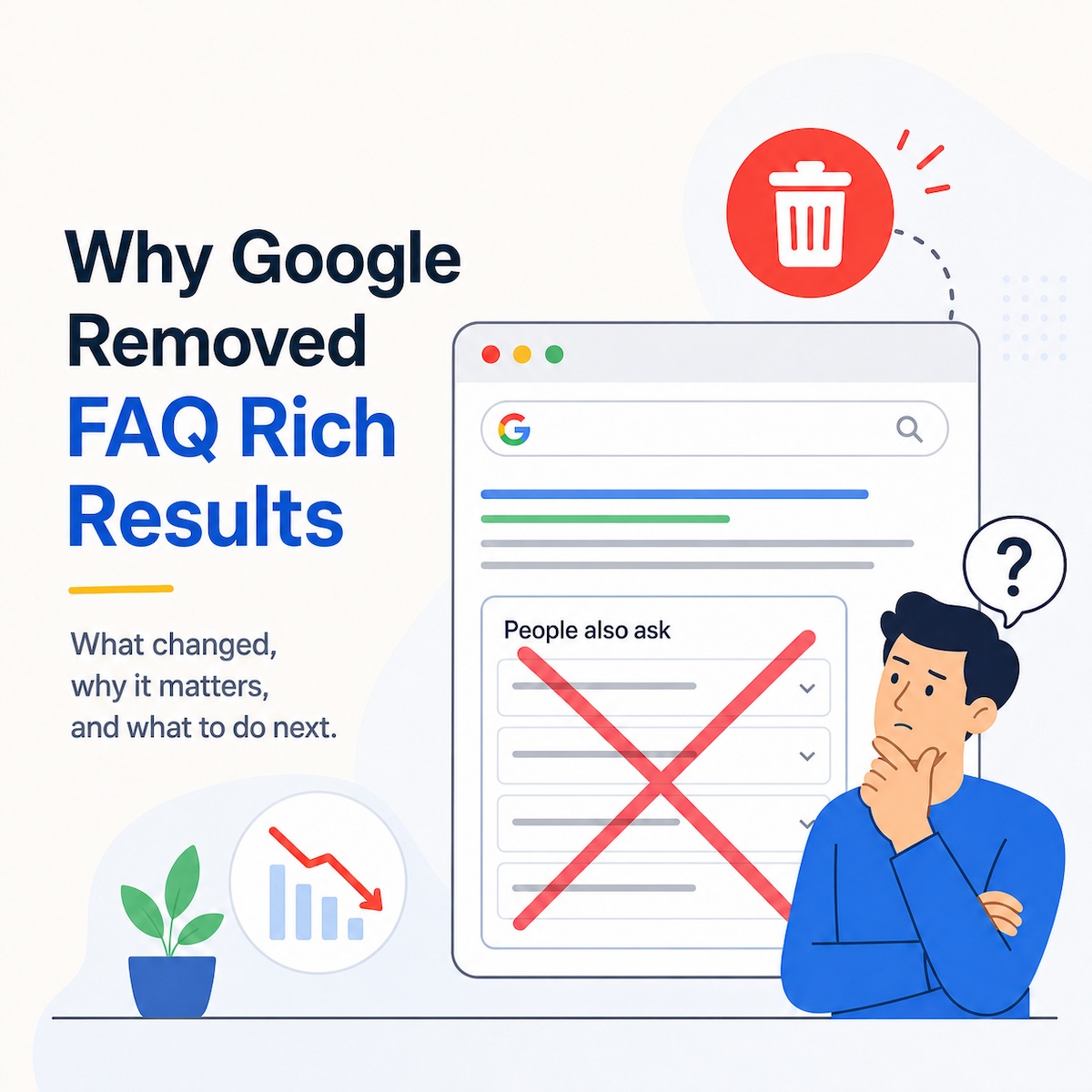
Checking your Search Console performance report lately and seeing a drop in impressions? If it started around May 7, 2026, there’s a good chance FAQ rich results are behind it. Google has officially removed FAQ rich results from search, and the impact is already showing up in performance reports across the board.
This is one of those changes that affects a wide range of websites, so if you’re seeing lower impression counts in your rich result reports, you’re not alone. Let’s break down what happened, why it matters, and, most importantly, what you should actually do about it.
What Changed on May 7, 2026
As of May 7, 2026, FAQ rich results no longer appear in Google Search. If your pages previously displayed an expandable list of questions and answers directly in the search results, that feature is now gone.
As a direct consequence, Google Search Console’s performance report is now showing a drop in impressions for FAQ-type content. This isn’t a bug or a logging error, the rich result has simply been removed from the search experience entirely.
Google did acknowledge this on their Search Console Data Anomalies page, confirming that any impression drop related to FAQ is expected following this change.
Why Did Google Remove FAQ Rich Results?
Google hasn’t released a lengthy explanation for this decision, but the move lines up with a broader trend we’ve been seeing: Google is simplifying what shows up in search results and placing a heavier emphasis on its own AI-generated features, like AI Overviews.
For a while, FAQ rich results were a popular way to take up more real estate in search results. A page could show multiple expandable questions beneath its listing, which helped with visibility and click-through rates. But over time, Google began limiting FAQ rich results to only a small number of authoritative sites, and now, that limited rollout has been cut entirely.
The result? A cleaner search results page, and less room for websites to stand out through structured data alone.
Should You Remove Your FAQ Section?
Not really, and this is important.
The FAQ rich result disappearing from search does not mean your FAQ content is worthless. In fact, removing your FAQ sections entirely would likely do more harm than good.
Here’s the thing, FAQ content serves your users first. When someone lands on a product or service page and has questions, a well-written FAQ section keeps them on your page longer, reduces friction, and helps move them toward a decision. That’s still valuable whether Google is displaying it in search results or not.
Beyond user experience, FAQ content also gives your page more depth and relevance around the topics your audience is searching for. Thin pages with no supporting content don’t perform as well in organic search, and stripping out FAQ sections could work against you.
Keep the content. Just adjust your expectations around how it shows up in search.
Keep Your FAQ Schema in Place, Here’s Why
Even though FAQ rich results are no longer appearing visually in search, it’s still worth keeping your FAQ schema markup in place. Here’s why.
Google’s systems use structured data to better understand the content on your pages. While FAQ schema may not be triggering a visual feature in search right now, it still helps Google categorize and process your content accurately. Removing it doesn’t give you anything, and keeping it leaves the door open if Google reverses course or introduces a new feature that uses it.
Think of it like keeping a clean, well-organized backend even when users don’t see it directly. It’s still doing work behind the scenes.
If your pages don’t already have FAQ schema applied, now is a good time to add it, not because it’ll produce a rich result today, but because it supports your long-term SEO health. Schema markup is one of those foundational pieces of technical SEO that pays off over time.
How AI Is Changing the Way FAQ Content Gets Discovered
This is where things get interesting, and where the real opportunity lies right now.
With Google’s AI Overviews becoming more prominent in search results, the game has shifted. AI Overviews pull information from across the web to answer user queries directly in the search results page. And structured, well-written FAQ content is exactly the kind of material that feeds into those summaries.
In other words, even though your FAQ rich result is gone, your FAQ content could still be surfacing in search, just inside an AI Overview instead of as a standalone expandable list.
Here’s how to position your FAQ content to be picked up by AI-generated features:
- Write clear, direct answers. AI systems favour content that answers a question concisely and completely in the first few sentences. Avoid burying the answer in a long preamble.
- Use natural, conversational language. AI Overviews tend to pull from content that reads the way people actually talk. Overly technical or jargon-heavy answers are less likely to be surfaced.
- Keep questions specific. Broad questions produce broad answers. Specific, relevant questions that your customers actually ask are much more likely to match real search queries.
- Make sure your page demonstrates authority. AI systems are more likely to pull from pages that Google considers trustworthy. This means having solid backlinks, consistent content, and a well-optimized overall site.
The shift from traditional rich results toward AI-driven discovery isn’t slowing down. Getting your content ready for this new landscape is one of the smartest moves you can make right now.
Spot a Drop? Let’s Sort It Out Together.
Google changes happen fast, and it’s not always easy to know what’s a normal shift versus something that needs attention. At Bluedot Marketing, we keep a close eye on updates like these, so our clients don’t have to piece it together on their own.
If you want to make sure your site is set up to weather these kinds of changes, with the right structured data, content strategy, and technical foundation, let’s talk. We’re here to help you stay ahead, not just catch up.
Looking for SEO support that keeps up with how search actually works today? Get in touch with us today!